Teaching Models
Differentiation is an important consideration when planning a unit of work. We would primarily differentiate through lesson outcomes as the tasks included will provide for a wide range of responses. Their breadth will ensure that the tasks will be accessible to students who require learning support and would also provide stretch and challenge for our most able. The unit will also include resources to support student learning and the inclusion of teacher scaffolding.
Catering for Inclusion:
We have consciously developed activities and structure the unit of work to meet the needs of a diverse range of learning styles. We have considered Gardner’s Multiple Intelligences in order to cater for all our students’ needs.
Bodily-kinesthetic learners had opportunities to build 3D models of their memorial designs.
Linguistic learners could participate in oral presentations of their proposed playground designs.
Spatial learners could use imagery and videos when researching the affects of the fires on their local community.
Logical-mathematical learners could participate in the development of scaled plans of the playground that ensured that our unit of work included numeracy activities involving space and measurement.
Intrapersonal learners could be involved in independent activities such as the design of their treasure map and fire prevention action plan.
Intrapersonal learners could work collaborative with others in group activities such as the analysis of survey data from the local community.
Naturalistic learners could analyse the impact of the bush fires on local wildlife and flora and fauna that therefore meets the learning approaches of naturalistic learners.
Thinking involved:
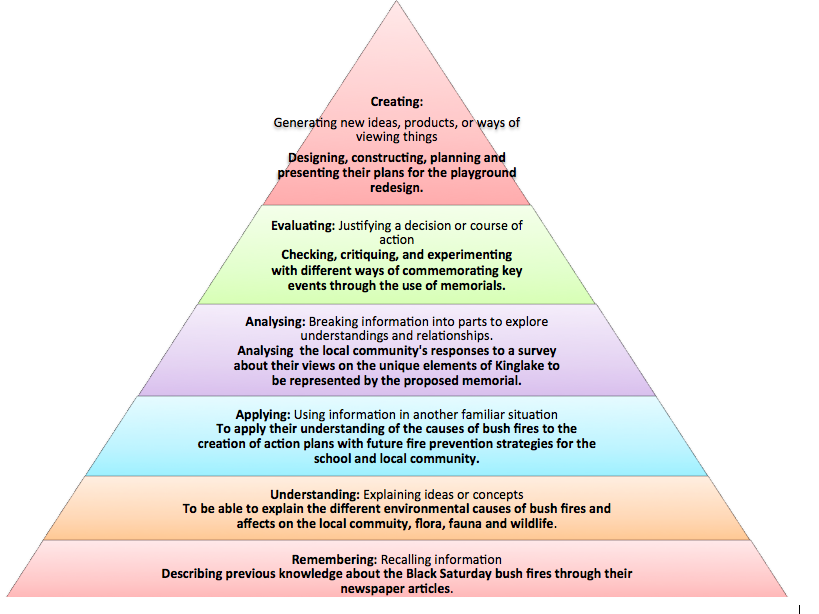
How will students build deeper understandings through this unit – consider Bloom’s taxonomy.
We have structured the Iquest using the stages of Bloom’s taxonomy. This has enabled us to apply this pedagogical approach to help students develop deeper understandings of the causes of bush fires and their effects; to commemorate those affected and to move forward as a school community. We also believe that Bloom’s model provides a framework to monitor student progression.